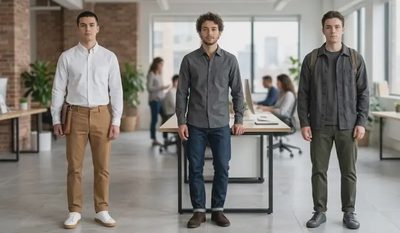

Most guys land in a casual office and default to one of two uniforms: the logo polo with baggy khakis, or the blue button-up with black slacks that screams "I stopped trying in 2018." Neither is wrong exactly. Both are forgettable. And if you spend eight hours a day somewhere, being forgettable isn't the goal.
The trap men fall into is mistaking "office appropriate" for "anything with a collar." A collar doesn't fix bad fit. A button-up doesn't save limp fabric. The result is a wardrobe that checks the dress code box but communicates nothing. Looking clean and capable in a casual office isn't about wearing more interesting clothes. It's about wearing a few well-chosen pieces that fit and repeating them with enough variation that the repetition reads as consistency, not laziness.
The Foundation Pieces That Do the Heavy Lifting
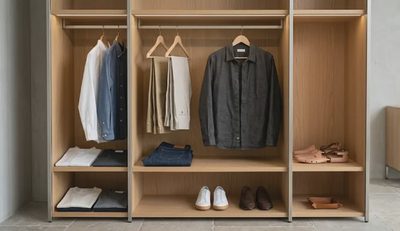
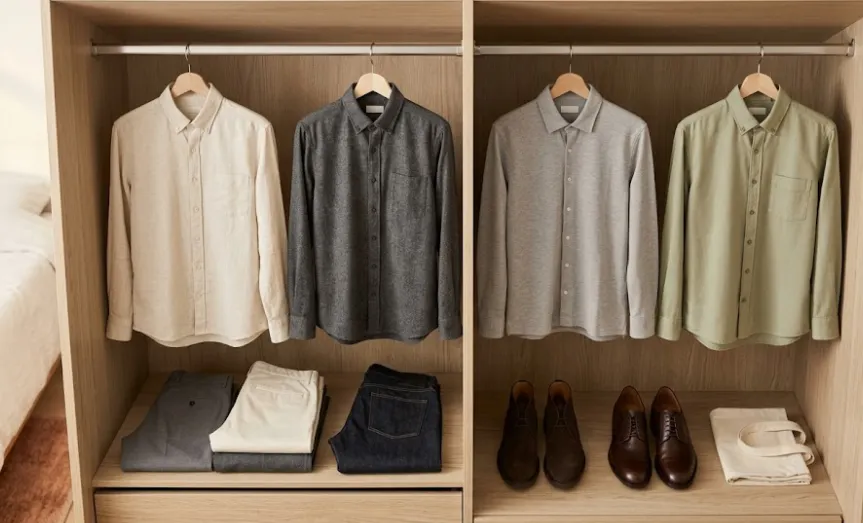
You don't need a closet full of statement pieces. You need a small set of items where fit, fabric weight, and texture work together. Here are the seven pieces that form the backbone of an office wardrobe that looks adult without looking stiff.
Piece | Why It Matters | Look For |
|---|---|---|
Oxford button-down, white | Bridges casual and competent. Works tucked or untucked. | Shoulder seam on bone, body length hits mid-fly, collar has enough body to sit under a sweater |
Poplin or lightweight button-up, light blue | Warmer-weather alternative to oxford cloth. Drapes lighter, reads as intentional even untucked. | Clean placket, matte finish, no shiny synthetic blends |
Heavyweight crew-neck tee, charcoal or cream | The anchor of layered casual days. Worn under an overshirt, it looks pulled together in five seconds. | 200+ GSM, ribbed neckline with recovery, boxy cut that skims the torso |
Straight chino trousers, khaki or stone | The daily driver. Clean vertical line, no pulling, no pooling. | Mid-rise, straight through the thigh, single clean hem break |
Dark straight jeans, indigo or black | Friday option that still reads as effort. | No distressing, no contrast stitching, no fading at the thigh |
Unstructured overshirt, olive or navy | Instant structure without a blazer. Worn open, it frames the torso. | Shoulder seam on bone, hem at mid-fly, matte fabric with enough weight to hold shape |
Clean leather sneakers or plain-toe shoes | Grounds every outfit without dragging it into gym or boardroom territory. | No mesh, no reflective stripes, no visible branding |

Fit and Texture Beat Loud Colors Every Time
The reason most casual office outfits look boring isn't the lack of color. It's the lack of texture and shape. A flat, shiny blue dress shirt tucked into flat, shiny black trousers reads as uniform. Swap the shiny shirt for a matte oxford with visible weave texture, and swap the black trousers for textured khaki chinos, and the outfit changes completely. Same colors. Completely different signal.
Texture does the work that patterns and logos usually fail at. A heavyweight cotton tee has surface grain. A pair of chinos in a crosshatch weave catches light differently than smooth twill. An overshirt in slub cotton or brushed twill adds depth without adding noise. These things register even when nobody names them.
Fit is the other half. A straight trouser that falls cleanly from the hip creates a long vertical line that reads as intentional, not accidental. A shirt with a shoulder seam that sits exactly on the bone frames the upper body without looking stiff. If the fit is right, the outfit can be simple. Simple plus good fit reads as confident. Simple plus bad fit reads as sloppy.
How to Repeat Without Looking Repetitive
The fear men have is that owning fewer pieces means people will notice they wear the same thing. In practice, the opposite happens. When your clothes fit and the palette is consistent, people notice you look put together. They don't catalog your outfits.
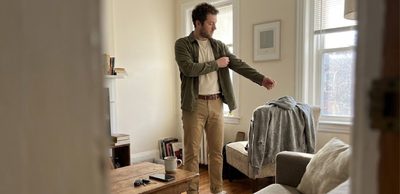
The rotation that works: let one piece change while the rest stay the same. Monday is white oxford with khaki chinos and leather sneakers. Tuesday is the same chinos and sneakers with a light blue poplin shirt. Wednesday layers the charcoal tee under an olive overshirt. Each day shifts one element. The silhouette stays clean. The impression stays consistent.

Where to Invest and Where to Save
Put your money into the pieces that define the silhouette. Shoes sit at the bottom and anchor the whole line. If the shoes are wrong, the outfit collapses from the ground up. Spend more there. The overshirt and oxford shirt frame the upper body and sit near your face. Spend mid-range there and check the shoulder seam religiously.
Chinos can be mid-range. A pair from a brand that understands straight fit will perform well at a reasonable price. Tees can be cheap, but not thin. The weight of the cotton is more important than the price tag.
The Real Difference
Most casual offices are full of men wearing clothes that fit passably in colors that don't offend anyone. You don't need to be the most stylish person in the room. You need to be the one whose clothes look like they belong to him and not to a dress code. That comes from fit first, texture second, and a small rotation of pieces that work together. Not more clothes. Better shape.