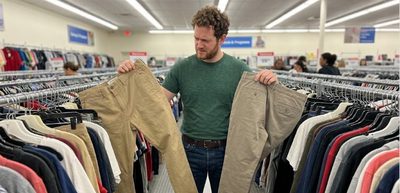

Outlet shopping is a game, and most men don't even realize they're playing it. You walk in, see a price tag that says "$98 suggested retail price," then feel clever for buying it for $39. But that comparison price is often fabricated. What's more, in far too many cases, the garment itself is also made specifically for outlets (not the same quality as full-price store items).
I've seen this from both sides. As a production developer, I handled samples destined for full-price retail and samples destined for outlet channels. They looked similar on the hanger. They were not the same garment. The outlet version used lighter fabric, simpler construction, and a pattern that had been stripped of the adjustments that made the retail version fit right. The discount was real. The value was not.
Understanding how outlets actually work changes how you shop them. The goal isn't to buy nothing. It's to buy the things that are genuinely the same quality at a lower price, and leave the rest.
What's Actually Worth Buying at Outlet Stores
Category | Why It's Worth It | What to Check |
|---|---|---|
Heavyweight cotton tees | Simple construction is hard to cheapen without making it obvious. Weight hides shortcuts. | 200+ GSM, ribbed neckline with recovery, no visible sheen |
Straight-leg chinos | Simple pattern with few failure points. Mid-rise straight cut is consistent across channels. | Side seam hangs straight, matte fabric, clean hem fold |
Unstructured overshirts and chore coats | No shoulder pads or canvas to cheapen. Relaxed fit forgives minor construction drift. | Shoulder seam sits on bone, hem hits mid-fly, buttons have thread shanks |
Basic leather sneakers | Retail versions are already overpriced. Outlet versions from the same factory often differ only in packaging. | Clean stitching, no glue marks, leather that doesn't feel like plastic |
Socks and underwear packs | Same cotton, same elastic, lower price. The one category where "made for outlet" barely matters. | Check fiber content tag, not the front label |

What's Usually Not Worth It
Category | Why It Fails | What Goes Wrong |
|---|---|---|
Tailored jackets and blazers | Shoulder construction and canvas require skilled labor. Outlet versions use fused interlinings that bubble after dry cleaning. | Shoulder pads misaligned, lapels won't roll, polyester lining traps heat |
Slim-fit and stretch-heavy pants | Stretch fabric amplifies pattern errors. Outlet versions often use lower-grade elastane that bags out permanently. | Knees bag after three wears, side seams twist, waistband loses grip |
Graphic tees and logo-heavy pieces | Prints crack faster on the thinner outlet fabric. Logos are often slightly altered from the retail version. | Print peeling, off-register alignment, faded after five washes |
Dress shirts with spread collars | Collar interlining is the first thing downgraded. Outlet versions go limp after two washes. | Collar curls, placket twists, buttons loosen from single-pass stitching |
Suits and suit separates | The entire construction model changes for outlet. Fused instead of half-canvas, polyester instead of bemberg lining, plastic buttons instead of horn. | Looks stiff on the body, doesn't move, shines under natural light |
How to Spot Made-for-Outlet in 30 Seconds
Most men can't tell the difference between a mainline garment and its outlet version. Here are four giveaways I learned to spot during my years on the production side.
First, check the inner tag. Mainline garments often have a style code or a season code. Outlet-specific garments sometimes use a different numbering system, or they'll say "Factory" in small print somewhere on the tag. If the tag looks slightly different from what you remember in the mainline store, trust that instinct.
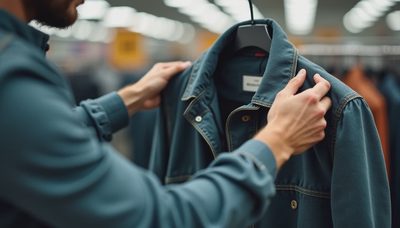
Second, check the buttons and hardware. Mainline buttons are often natural materials — shell, horn, corozo, or thick resin with a polished finish. Outlet versions switch to thin, lightweight plastic with mold lines visible around the edge. That's a cost cut you can see instantly.
Third, check the seam finishing. Turn the garment inside out. A mainline jacket will have bound seams, clean overlocking, or French seams on finer fabrics. The outlet version will have raw overlock edges with loose threads. More threads hanging inside mean fewer seconds spent on each garment.
Fourth, check the fabric weight in your hand. Crumple a section of the fabric gently. If it stays crumpled or feels lighter than you expected, the fabric was downgraded. Mainline fabric has more body and recovers its shape after you release it.

How to Raise Your Hit Rate
Go in with a list, not a mood. Outlet stores are designed to make you browse, and browsing leads to buying things you don't need that don't fit. I walk straight to the categories I trust — pants, tees, overshirts — and ignore everything else unless something genuinely surprises me.
Check every garment individually. Two identical-looking shirts on the same rack can come from different production runs. One might be a mainline return, the other a made-for-outlet copy. The shoulder seam and the inner tag will tell you which is which.
Walk out empty-handed more often than not. I leave outlets with nothing on more than half my trips. The real savings isn't buying more for less. It's buying nothing when nothing is right. A bad deal on a bad garment is still a loss. A good deal on a good garment is only good if you actually need it.
The outlet isn't the enemy. The idea that everything there is a deal is the enemy. Go in knowing the difference between what was made to be sold and what was made to be discounted. Buy the first. Leave the second.