
Walk through any discount store and run your eyes across the jacket section. Don't look at the price tags. Look at the shoulders. In seconds, you can spot the jackets that will never hang right — the seams that drop off the bone, the sleeves that collapse, the diagonal pulls from collar to armpit. None of that is the fabric's fault. It's the pattern, and it starts at the shoulder.
During production development, the shoulder was always the first fit point we checked on a new sample. If the shoulder was wrong, we stopped the review right there. No one looks at the cuff or the hem length when the entire garment hangs from the wrong starting point. The shoulder is where a jacket announces whether it was cut by someone who understands bodies, or someone who just traced an old block and shipped it.
What Happens When the Shoulder Is Wrong
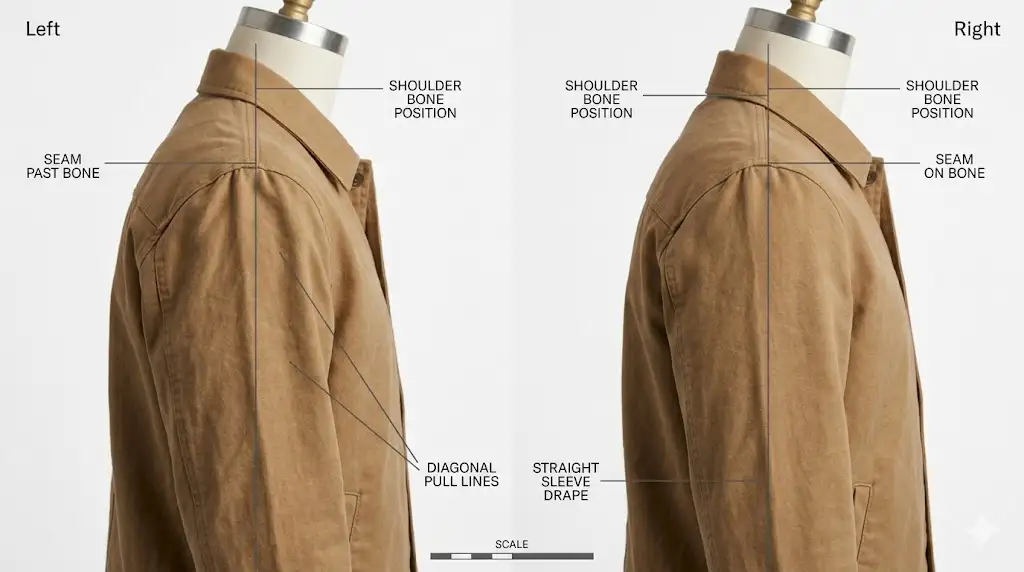
A shoulder that's too wide drops the sleeve head off the bone. The upper arm collapses inward, the fabric buckles, and the whole silhouette softens into something shapeless. A shoulder that's too narrow pulls the sleeve up and creates diagonal tension lines from the neck to the armpit. The jacket looks borrowed, not bought. Both problems come from the same root: the pattern block wasn't adjusted for the actual shoulder width of the man who will wear it.
On a tailored jacket, there's one more variable: the shoulder pad. A pad that's too thick pushes the sleeve cap upward and creates a lifted ridge at the shoulder point. A pad that's too thin on a structured jacket leaves the shoulder without any architecture, and the sleeve collapses just the same. Budget jackets often get the pad thickness exactly wrong — either overbuilt to hide bad cutting, or underbuilt to save cost.
Common Shoulder Problem | What It Looks Like | Why It Happens |
|---|---|---|
Too wide | Seam drops off the bone, sleeve head collapses, fabric sags | Block graded outward without adjusting for real shoulder slope |
Too narrow | Diagonal pulls from collar to armpit, sleeve rides up with movement | Size scaled down from a broader fit model without recutting the armhole |
Wrong sleeve pitch | Sleeve twists forward, shoulder lifts when arms reach | Armhole angle doesn't match natural forward-leaning stance |
Shoulder slope mismatch | Gap between collar and neck, pull lines at the chest | Flat shoulder line cut for a body with more slope and less muscle |
What Most Guys Miss About Shoulders
Men tend to check shoulder fit by shrugging or looking in the mirror head-on. That tells you nothing useful. The shoulder is a side-view problem. Turn sideways. Run your thumb along the top of your shoulder until you feel the bony edge. That's where the seam must end. Not an inch further. Not pulled inward.
The second thing men miss is sleeve pitch. Pitch is the angle the sleeve is set into the body. A well-pitched sleeve hangs straight when your arms are at your sides and stays straight when you reach forward. A badly pitched sleeve twists. No amount of discount makes a twisted sleeve worth buying, because fixing it means recutting the armhole. Most tailors won't touch it, and the ones who will charge more than the jacket cost.
The Quick Test That Works Every Time
Before you check the label, before you feel the fabric, before you look at the price, do this. Put the jacket on. Stand sideways in the mirror. Place your index finger on the very edge of your shoulder bone. If the seam is forward of your finger, the shoulder is too narrow. If it's past your finger by more than a quarter-inch, it's too wide. If it's sitting under your finger on the bone, the jacket passed the first and hardest test. Now check the price. If the shoulder is right, a 60-dollar jacket can look better than a 300-dollar jacket with bad shoulders. That's not opinion. That's pattern geometry.
The shoulder is where the whole jacket begins. Get that seam on the bone, and the rest can usually be adjusted, hemmed, or worn as-is. Miss it, and nothing else matters. Start there every time. Your body is the reference. The pattern either works with it or it doesn't. The price tag comes after.